
Foundation Cracks: Which Are Normal and Which Are Serious?
Most homes in Shreveport, LA have a crack somewhere. Plenty are harmless. A few point to a foundation that is moving. This guide walks through the common crack types in slab and pier-and-beam homes, what each one often means, and how to tell whether yours is changing.
Shreveport Foundation Services is a free quote service, not a foundation company. Independent local companies, which may pay to receive requests, reply to homeowners with quotes, and the company you choose does the work. A crack guide is not a diagnosis. Only someone who looks at the house can tell you what is going on.
Are foundation cracks normal?
Many are. Concrete shrinks as it cures, and thin cracks in a slab are common in houses that are otherwise fine. Mortar and drywall crack with small, early movement and then stay put. What matters is less the crack itself than four things around it:
- Offset: one side of the crack sits higher or farther out than the other.
- Shape: the crack is wider at one end than the other.
- Change: it grows, or it reopens after it was patched.
- Company: it shows up with sticking doors, windows that will not latch, sloping floors or gaps at trim.
One thin crack with none of those is usually something to watch. Several of them together usually earn an inspection.
Common crack types at a glance
| What you see | What it often means | Sensible next step |
|---|---|---|
| Hairline crack across a slab, flat, no offset | Concrete shrinkage is a common cause | Mark, date and photograph it |
| Thin drywall crack at a door or window corner | Minor movement; matters more if doors also stick | Watch it with the doors nearby |
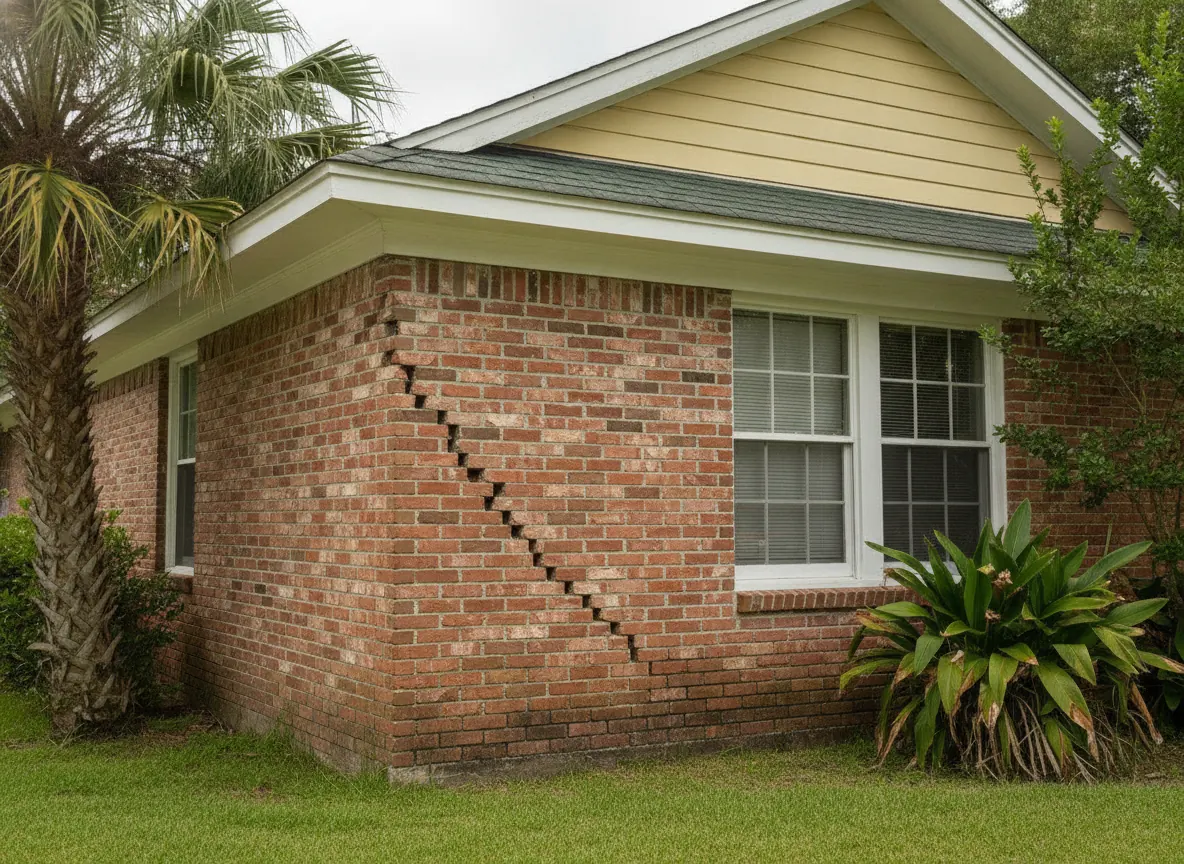
| Stair-step crack along brick mortar joints | Movement in the wall or the foundation under it | Track it; ask about the cause before repointing |
| Crack wider at one end | One part of the house moving more than another | Get an inspection |
| Slab crack with one side higher | Uneven movement of the slab | Get an inspection |
| Crack that reopens after patching | Movement is ongoing | Find the cause before sealing again |
| Cracked or leaning brick pier in the crawl space | A pier that settled, heaved or is deteriorating | Pier-and-beam inspection |
A rough guide, not a diagnosis. The same crack can mean different things in different houses.
Slab cracks
Most newer homes around Shreveport and Bossier City, LA are slab-on-grade. You often find slab cracks when the carpet comes up or a tile line cracks. A flat hairline crack with no height difference is common. A crack where you can feel a lip with your finger, where tile has popped along a line, or where the floor slopes toward the crack is different, because it suggests part of the slab moved. On clay soils the slab edge can lift or settle with the seasons. See slab foundation repair for what companies check, including floor elevations and, sometimes, a plumbing test under the slab.
Brick veneer cracks
Brick on many homes is a veneer, a skin over the frame. Because mortar is weaker than brick, movement tends to show as a stair-step crack along the mortar joints, often starting at the corner of a window or door, where the wall has an opening. A crack that runs straight through the bricks themselves, or brick that has pushed out of line, usually means more force. Repointing closes the crack, but if the foundation under it is still moving, the crack can come back.
Cracks in pier-and-beam homes
Many older Shreveport homes, especially in districts like Highland, Fairfield and South Highlands, sit on piers over a crawl space. In these houses the clues are often inside: cracked plaster or drywall, doors that drift out of square, and floors that dip or feel soft. Under the house, look for cracked, leaning or crumbling brick piers, gaps between a pier and the beam, and damp or soft wood. The fix is often at a pier or in the framing, not at the crack. See pier and beam repair and crawl space repair.
Why cracks open and close here
Much of Caddo and Bossier parishes is mapped in clay soils with high to very high shrink-swell potential (USDA NRCS soil data): roughly 43% of Caddo and 55% of Bossier by area, including Red River clays like Moreland and Buxin and upland soils like Eastwood and Keithville. Check your own lot on Web Soil Survey. Clay like that swells when wet and shrinks as it dries, which can contribute to cracking. Shreveport's weather drives the cycle: April is the wettest month, at about 5.2 inches of rain, and August the driest and hottest, at about 2.9 inches with average highs near 94.9 °F (NOAA 1991–2020 normals). That is why a crack can look worse in September than in May. Read more in how Red River clay can move Shreveport foundations.
How to track a crack
Mark the ends
Draw a short pencil line across each end of the crack and write the date.
Photograph it
Take a photo with a ruler or tape in the frame, from the same spot each time.
Check the doors
Note which doors and windows stick or will not latch, and when.
Recheck by season
Look again after the late-summer dry spell and after spring rains.
A few months of notes tell a company or engineer far more than a single photo. They also help a future buyer's inspector.
When to bring in an engineer. If a crack is offset or widening, comes with sticking doors and sloping floors, or the quotes you get disagree, an independent LAPELS-licensed professional engineer can assess the house before you sign. This Old House puts an inspection at about $300–$1,000 (average about $600). The engineer should be independent of the company selling the repair. See foundation inspections.
What crack repair typically involves
For a crack that is only cosmetic, a company may seal concrete cracks with epoxy or polyurethane injection and repoint cracked mortar. For a crack that is a symptom, the work goes to the cause: drainage and grading, piers under a slab, or shimming and added piers under a pier-and-beam house. Sealing a crack does not stop the soil from moving, so sealing alone on a house that is still moving may need redoing.
No crack-only figure is included in the cost guides used here, so compare written quotes. When the crack is a sign of movement, the price follows the fix. National guides put most foundation repairs at $2,200–$8,200 (Fixr, January 2026) and per-pier underpinning at $1,000–$3,000 per pier (Fixr, This Old House). The Shreveport foundation repair cost guide has the full table, and foundation crack repair covers what to ask.
Before you hire anyone
Ask each company whether the crack is cosmetic or structural and what it measured to decide, and whether the scope deals with the cause or only seals the crack. Ask what the warranty covers, whether it transfers to a buyer, and get it in writing. Louisiana's contractor board (LSLBC) changed its thresholds on August 1, 2024. Home improvement registration now covers most projects of $7,500 to under $50,000, but structural work such as foundations, footings and floor slabs is excluded from 'home improvement', so foundation repair over $7,500 generally calls for an LSLBC-licensed contractor. Look the company up at lslbc.louisiana.gov and ask for the license number, proof of liability insurance and the permit. When you are ready, request free quotes.
Frequently asked questions
Is a hairline crack in my slab serious?
Usually not on its own. Concrete shrinks as it cures, and flat hairline cracks with no height difference are common. Mark the ends, date it and photograph it. It is worth a closer look if one side rises above the other, it keeps growing, or doors and floors nearby start to change.
Are stair-step cracks in brick a sign of foundation problems?
They can be. A stair-step crack along the mortar joints shows that the wall or the foundation under it moved. Some move once and stop. If the crack widens over the seasons, one side sits out of line, or nearby doors and windows stick, get an inspection before paying for repointing.
Can I just seal a foundation crack?
Sealing can keep out water and pests and is reasonable for a stable, cosmetic crack. It does not stop movement. If the crack reopens after patching or comes with other signs, find the cause first, because sealing a crack on a house that is still moving may need redoing.
Which foundation cracks need an engineer?
Cracks that are offset or wider at one end, cracks that keep growing, and cracks that come with sticking doors or sloping floors are good reasons to get an independent LAPELS-licensed engineer. So are conflicting repair quotes or a home sale. This Old House lists about $300–$1,000 for an inspection.