
How Red River Clay Soil Can Move Shreveport Foundations
If you own a home in Shreveport, LA, someone has probably blamed "the clay" for a cracked brick wall or a door that sticks every August. There is real soil science behind that. Here is what the federal soil maps show for Caddo and Bossier parishes, how the weather feeds the cycle, and what it can mean for slab and pier-and-beam homes.
Shreveport Foundation Services is a free quote service, not a foundation company. Independent local companies, which may pay to receive requests, reply to homeowners with quotes, and the company you choose does the work. This article is general information, not an engineering opinion about your house.
What is expansive clay soil?
Some clays take on water and swell, then shrink and crack as they dry. Soil scientists rate this with a number called linear extensibility percent (LEP), a measure of how much a soil changes in volume between wet and dry. Under the class breaks used by USDA soil scientists (as quoted by UC Davis SoilWeb), an LEP below 3 is low, 3 to 6 is moderate, 6 to 9 is high, and 9 or more is very high.
The clays that move most around here are smectitic clays, a clay mineral group known for swelling. Two of the Red River series, Moreland and Buxin, are Vertisols, the soil order made of clay that cracks when dry and swells when wet. Clay like that can push up on a slab edge when it swells and pull away from it when it shrinks.
How much of Caddo and Bossier is shrink-swell clay?
Much of Caddo and Bossier parishes is mapped in clay soils with high to very high shrink-swell potential (USDA NRCS soil data): roughly 43% of Caddo and 55% of Bossier by area, including Red River clays like Moreland and Buxin and upland soils like Eastwood and Keithville. Check your own lot on Web Soil Survey. The parish figures below come from USDA NRCS Soil Data Access, counting the main soil in each map unit. They cover Greenwood, LA, Blanchard, LA, Keithville, LA, Bossier City, LA, Benton, LA, Haughton, LA, Minden, LA and Stonewall, LA.
| Parish (main towns) | Share with high or very high shrink-swell in some layer | Share where NRCS lists shrink-swell as a limit for homes |
|---|---|---|
| Caddo (Shreveport, Greenwood, Blanchard, Keithville) | About 43% | About 47% |
| Bossier (Bossier City, Benton, Haughton) | About 55% | About 58% |
| Webster (Minden) | About 31% | About 26% |
| De Soto (Stonewall) | About 63% | About 63% |
Shares of mapped acres from USDA NRCS soil data (SSURGO). Mapped urban land and water are not rated. The "limit for homes" column is the NRCS rating for dwellings on shallow foundations.
Bossier Parish comes out highest of the two core parishes. Minden in Webster Parish is lower, partly because the Darley soils on its uplands are kaolinitic and shrink and swell little. Stonewall in north De Soto Parish sits in the parish with the highest share of the four.
Which soils show up around Shreveport and Bossier City
| Soil series | Where it is mapped | Highest LEP | Shrink-swell class |
|---|---|---|---|
| Moreland | Red River flood plain, Caddo and Bossier | 17 | Very high |
| Ashford | Bossier Parish | 17 | Very high |
| Buxin | Red River backswamp clay | 11.7 | Very high |
| Eastwood | Uplands in Caddo and De Soto | 9.3 | Very high |
| Gore | Old river terraces in Bossier and Webster | 8.3 | High |
| Keithville | Uplands in south Caddo and De Soto | 7.5 | High |
| Sacul | Uplands in Bossier and Webster | 7.5 | High |
| Coushatta | Red River natural levees | 4.8 | Moderate |
| Severn | Silty and sandy Red River deposits | 1.5 | Low |
| Darley | Uplands around Minden | 1.5 | Low |
Two patterns stand out. On the river side, the worst shrink-swell soils are the red backswamp clays. NRCS describes Moreland as formed in clayey alluvium of Permian Red Bed origin. The siltier soils on the natural levees, such as Coushatta and Severn, rate lower. On the uplands, Eastwood and Keithville (west and south of the city) and Sacul and Gore (east, in Bossier and Webster parishes) pair clay subsoils with slow to very slow permeability, so water moves through them slowly. Keithville soils, a clayey upland series named for the Keithville, LA area, can hold perched water 2 to 3 feet down in winter and early spring.
Much of the city is mapped as "urban land" mixed with these soils, such as Urban land-Eastwood in Caddo and Urban land-Moreland in Bossier.
Why the weather matters as much as the soil
Clay moves when its moisture changes, and Shreveport's weather swings between wet and dry. NOAA's 1991–2020 normals at Shreveport Regional Airport show about 51.4 inches of rain a year. April is the wettest month at about 5.2 inches. August is the driest and hottest, at about 2.9 inches with an average high near 94.9 °F, and the city sees about 99 days a year at 90 °F or above. July through September bring under a fifth of the year's rain during the hottest stretch, so soil dries hard in late summer and wets up again in spring.
Drought adds to the swing. Caddo, Bossier, Webster and De Soto parishes each reached D3 "extreme" drought in 2022–2023 (U.S. Drought Monitor). Caddo peaked with 88.9% of the parish in D3 on September 19, 2023, and De Soto was fully in D3 on September 5, 2023.
What clay movement can look like in a slab home
Most newer homes in the area are slab-on-grade. When the soil under a slab edge swells or shrinks unevenly, the slab can lift at the edge or settle. That can show up as stair-step cracks in brick, cracks in the slab or the tile over it, doors that stick and floors that slope. None of these signs proves the soil is the cause, since drainage, plumbing and how the house was built also matter. See slab foundation repair for what local companies typically check, and foundation crack types for how to read a crack.
What it can look like in a pier-and-beam home
Many older homes in early-20th-century districts such as Highland (c.1890–1933), Fairfield (1900–1936) and South Highlands (1912–1949) sit on piers over a crawl space. On clay, individual piers can settle or heave on their own, so one room dips while the next stays level. Crawl spaces over slow-draining soils with seasonal perched water can stay damp, and damp crawl spaces raise the risk of wood rot and termites in sills and joists. Termite treatment is done by an LDAF-licensed pest control operator, not the foundation company. See pier and beam repair and why floors sag.
Soil maps are a starting point, not a verdict. Soils vary block by block, and urban fill is common, so a parish map cannot tell you what is under your slab. If the signs are serious or quotes disagree, an independent LAPELS-licensed professional engineer can assess the house, and may ask for a geotechnical soil report, which adds to the cost; ask for a written fee. See foundation inspections.
How to look up your own lot
Open Web Soil Survey
It is the free USDA NRCS soil map. Search for your address.
Draw your lot
Mark a small area around the house and open the soil map for it.
Read the map unit
Note the soil names, such as an Urban land-Eastwood complex or Moreland clay.
Check the ratings
Look at shrink-swell (linear extensibility) and the NRCS rating for dwellings.
What helps a house on clay
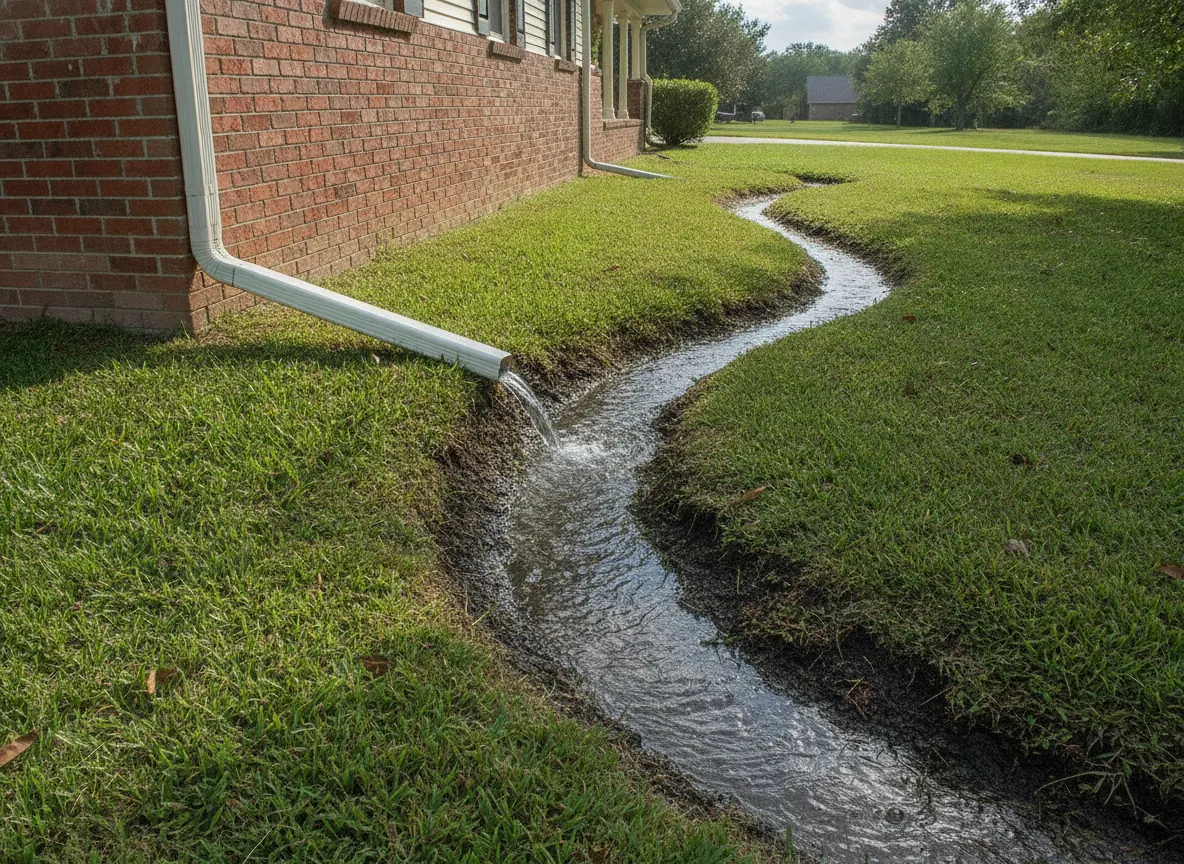
You cannot change the soil, but you can reduce big moisture swings next to the foundation. Keep gutters clear, extend downspouts away from the house, and make sure the ground slopes away from the walls so water does not pool at the slab edge or run into the crawl space. Those steps can help keep soil moisture more even, though they are no promise against movement. Drainage and grading covers the options local companies offer.
If movement has already happened, repair costs vary widely. Published national guides put most foundation repairs at $2,200–$8,200 (Fixr, January 2026), slab repair at $1,000–$10,000 and pier-and-beam repair at $2,000–$15,000. The Shreveport foundation repair cost guide has the full table and a calculator. When you are ready, request free quotes from independent companies serving the area. Call (318) 633-1685
Frequently asked questions
Does Shreveport have expansive clay soil?
Much of the area does. USDA NRCS soil data maps roughly 43% of Caddo Parish and 55% of Bossier Parish in clay soils with high to very high shrink-swell potential, including Moreland and Buxin near the Red River and Eastwood and Keithville on the uplands. Soils vary lot by lot, so check yours on Web Soil Survey.
Can clay soil cause foundation cracks?
Clay that swells when wet and shrinks when dry can contribute to foundation movement and cracking, especially through Shreveport's wet springs and hot, dry late summers. Drainage, plumbing leaks, the age of the house and how it was built also matter, so a crack is not proof of a soil problem. An inspection sorts out the cause.
Is the soil in Minden different from Shreveport?
Webster Parish, which includes Minden, has a lower share of high shrink-swell soils than Caddo or Bossier, about 31% by NRCS data. The Darley soils on Minden's uplands shrink and swell little, but Gore and Sacul soils, which rate high, are also common there. Check your own lot rather than assuming.
Do I need a soil test before foundation repair?
Not usually. Most repairs are planned from an inspection and floor elevation readings. An independent structural engineer may ask for a geotechnical soil report on a large or unusual job. That report adds to the cost, so ask for a written fee first.